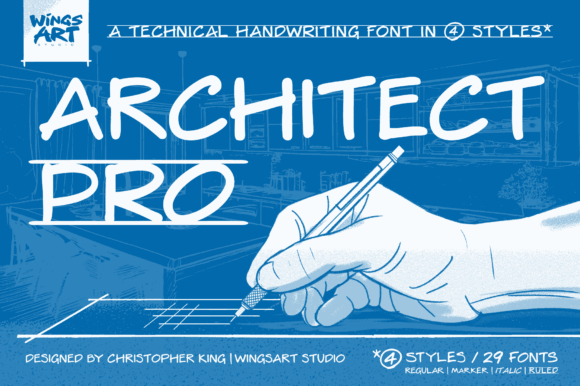
Architect Pro: A Typeface with Blueprint Precision
There’s a reason architectural lettering feels so satisfying to read. It’s born from a world where every millimeter matters, where a misplaced decimal or a poorly drawn “8” could cost thousands of dollars and weeks of delay. Before CAD software standardized our drawings, architects and draftsmen developed a handwriting style that prioritized absolute clarity above all else. It wasn’t about artistic flair—it was about communication that never failed. That legacy lives on in digital fonts like Architect Pro, which captures that same disciplined beauty and applies it to modern design challenges.
If you’ve ever struggled to find a typeface that feels both professional and approachable, technical yet warm, you’re not alone. Many fonts lean too far in one direction—either sterile and corporate or overly casual. Architect Pro sits in that rare sweet spot. It carries the authority of hand-lettered blueprints while remaining surprisingly versatile for everyday design work. Whether you’re building a brand identity, laying out a magazine spread, or designing packaging for a premium product, this font brings a quiet confidence that few others achieve.
Why This Style Still Matters in Modern Design
Architectural lettering emerged from necessity. In the early twentieth century, every line, dimension, and annotation on a blueprint was drawn by hand. Draftsmen needed text that could be reproduced quickly and consistently, yet remain legible even when reduced to tiny sizes on large-format drawings. The result was a style characterized by clean, uniform strokes, minimal ornamentation, and a geometric backbone that made each character instantly recognizable. Letters like “a” and “o” were often simplified to near-perfect circles. Strokes maintained consistent weight. Spacing was deliberate and even.
This wasn’t just about aesthetics—it was about safety and accuracy. When a contractor on a construction site needed to read a dimension or a material specification, there couldn’t be any ambiguity. A sloppy “5” that looked like an “S” or a rushed “1” that resembled a “7” could derail an entire project. So architects trained themselves, and their apprentices, to write with mechanical precision. Over decades, this practice evolved into an informal standard that became synonymous with professionalism and trustworthiness.
Today, that association still holds power. When people see architectural-style lettering, they subconsciously register qualities like precision, reliability, and thoughtful craftsmanship. These are exactly the qualities many brands want to communicate, whether they’re in construction, real estate, technology, or even food and beverage. Architect Pro taps into that visual language and makes it accessible for contemporary projects.
Where Architectural Lettering Shines Today
One of the greatest strengths of a font like Architect Pro is its adaptability across different media and contexts. Here are some practical applications where this typeface truly excels:
- Logo design and brand identity: For businesses that want to project competence and attention to detail, architectural lettering offers a distinctive yet professional voice. It works particularly well for engineering firms, architecture studios, construction companies, and design consultancies, but it’s equally effective for tech startups, craft breweries, or boutique retailers seeking a refined, handmade quality.
- Packaging design: Premium products often benefit from typography that suggests care and craftsmanship. Architect Pro’s clean lines and balanced proportions make it ideal for labels, boxes, and product inserts where readability at small sizes is essential.
- Editorial layouts and magazines: The font’s structured character makes it excellent for headlines, pull quotes, and subheadings in print publications. It pairs beautifully with both serif and sans serif body text, creating visual hierarchy without competing for attention.
- Web design and blogs: Digital screens demand fonts that render cleanly at various resolutions. Architect Pro maintains its clarity whether displayed on a Retina monitor or a mobile phone, making it a solid choice for website headers, navigation menus, and call-to-action buttons.
- Social media graphics: In a crowded feed, distinctive typography helps content stand out. The architectural style reads quickly and conveys authority, which is particularly useful for infographics, quote cards, and promotional banners.
- Invitations and event materials: For weddings, corporate events, or gallery openings, architectural lettering strikes an elegant balance between formal and personal. It suggests thoughtfulness without feeling stuffy.
- Merchandise and apparel: Tote bags, notebooks, t-shirts, and posters benefit from typefaces with strong visual personality. Architect Pro’s geometric foundation gives it a modern edge that works well in contemporary merchandise design.
- Marketing assets: From brochures and business cards to email headers and digital ads, consistent use of a distinctive font reinforces brand recognition across every touchpoint.
Practical Tips for Working with Architectural Fonts
Choosing the right typeface is only half the battle. How you use it matters just as much. Here are some observations from working with architectural-style fonts in real projects:
Consider the context first. Before selecting any font, think about where it will appear and who will see it. A font that looks stunning on a large poster might lose its character when used as body text on a website. Architect Pro works best at medium to large sizes where its letterforms can breathe. For smaller applications, ensure adequate line spacing and contrast against the background.
Test font pairings thoroughly. Architectural lettering pairs surprisingly well with a range of typeface categories. Try combining it with a clean sans serif for a modern, minimalist look, or pair it with a traditional serif for something more classic. Script fonts can also complement it nicely, especially when you want to add a touch of warmth or personality to a design. The key is contrast—pair a geometric architectural font with something that has a different rhythm or texture.
Pay attention to spacing. Fonts in this style often benefit from slightly looser letter-spacing than you might use with other typefaces. The uniform stroke width and geometric forms can feel dense if set too tightly. Experiment with tracking adjustments, especially in headlines and display text, to find the right balance between compactness and readability.
Think about color and weight. Architect Pro typically includes multiple weights and styles, giving you flexibility to create hierarchy within a single typeface family. Use bolder weights for headlines and lighter weights for supporting text. Be mindful of color contrast as well—architectural lettering tends to look its best in high-contrast combinations, such as dark text on a light background or white text on a deep, saturated color.
Review the full character set. Before committing to a font for a project, explore everything it offers. Many premium fonts include alternate characters, ligatures, extended language support, and special symbols that can add polish and versatility to your designs. Knowing what’s available helps you make the most of your investment and avoid unexpected limitations mid-project.
Understand licensing terms. If you’re using a font for commercial purposes—whether for a client project, a product you’re selling, or marketing materials for your business—make sure you have the appropriate license. Most premium fonts offer different tiers for personal use, single commercial projects, or broad enterprise applications. Reading the fine print upfront prevents headaches later.
Building a Cohesive Visual Identity
Typography is one of the most powerful tools for creating brand consistency. When you use the same typeface family across your website, social media profiles, printed materials, and packaging, you create a visual thread that ties everything together. People start to recognize your brand not just by your logo or color palette, but by the way your text looks and feels.
Architectural lettering offers a particularly strong foundation for this kind of consistency. Its clean, disciplined aesthetic adapts well to different contexts without losing its character. A headline on your homepage will feel connected to the text on your business cards. Your Instagram graphics will share visual DNA with your product labels. This kind of subtle repetition builds familiarity and trust over time, which is exactly what effective branding is designed to do.
For small business owners and independent creators, investing in a well-crafted typeface is one of the most cost-effective design decisions you can make. A single premium font family, used thoughtfully and consistently, can elevate your entire visual presence and communicate the level of care you bring to your work. In a world saturated with generic templates and overused free fonts, a distinctive typeface like Architect Pro helps you stand out while still feeling grounded and professional.